


Created by real people: Every post we publish is written by our team. AI plays only a small role for adjustments and polishing. We don’t aim for generic SEO content; our focus is on delivering authentic, high-quality value for the community.
App Store vs Play Store: Which One Wins in 2026? Data, Trends and Insights:
The mobile ecosystem continues to grow at an incredible pace, but not all platforms evolve in the same way.
In this article, we break down key insights from the App Store and Google Play, including app availability, market share, downloads, category distribution, average app pricing, and rating patterns.
More importantly, we translate this data into actionable insights to help you make better product and business decisions.
Market Share
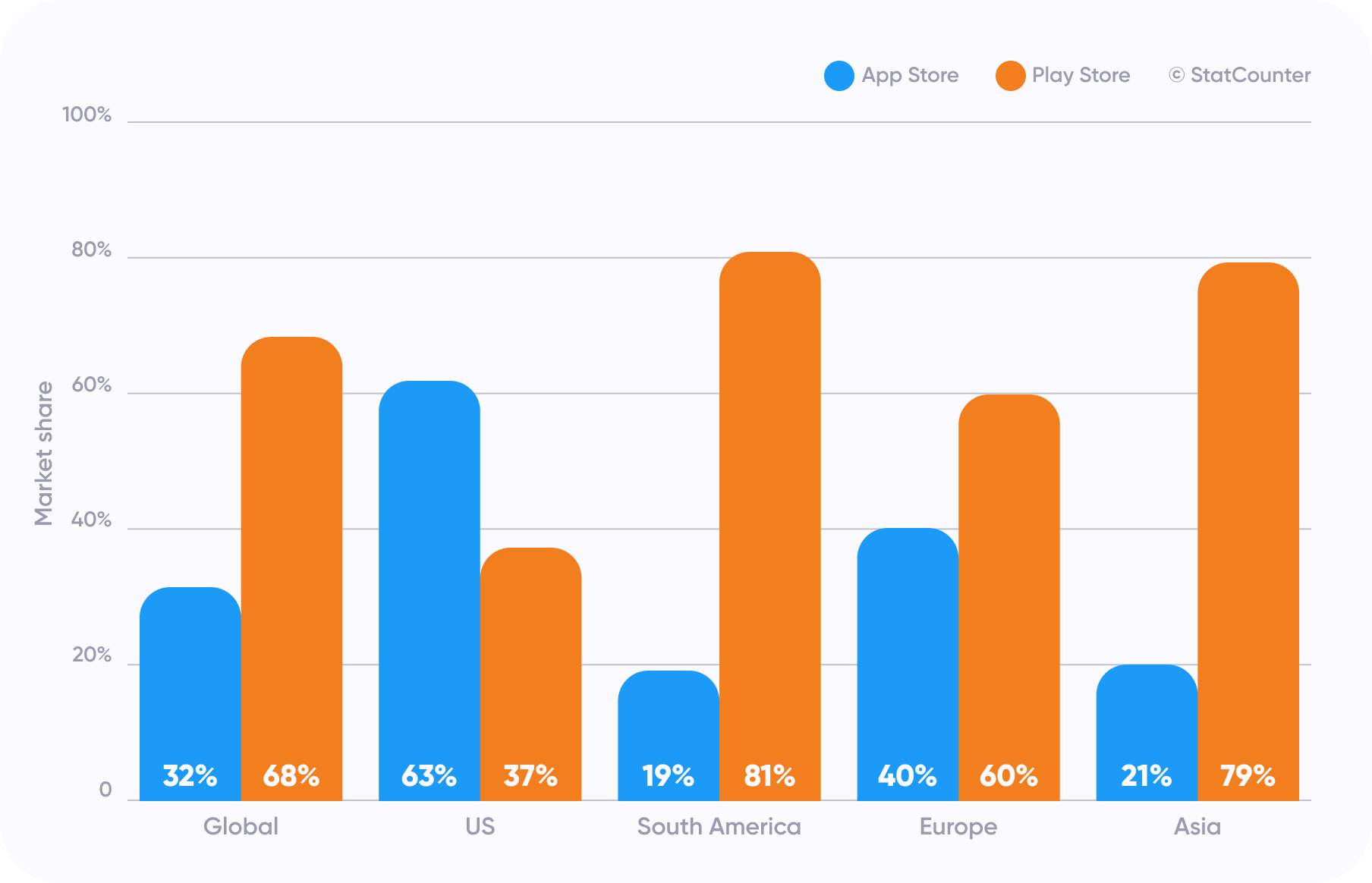
In 2026, Android dominates globally with ~68% market share, compared to ~32% for iOS (StatCounter).
However, the landscape changes significantly when we analyze by region:
- United States: ~63% iOS vs ~37% Android
- South America: ~81% Android vs ~19% iOS
- Europe: ~60% Android vs ~40% iOS
- Asia: ~79% Android vs ~21% iOS
This clearly shows that the mobile ecosystem is not uniform.
What matters is not just global share, but where your users are. iOS tends to dominate high-value markets where users are more likely to spend, while Android dominates high-volume markets where scale and reach are critical.
This distinction is key when defining your product strategy, especially if your app depends on monetization versus growth.
Overall Growth
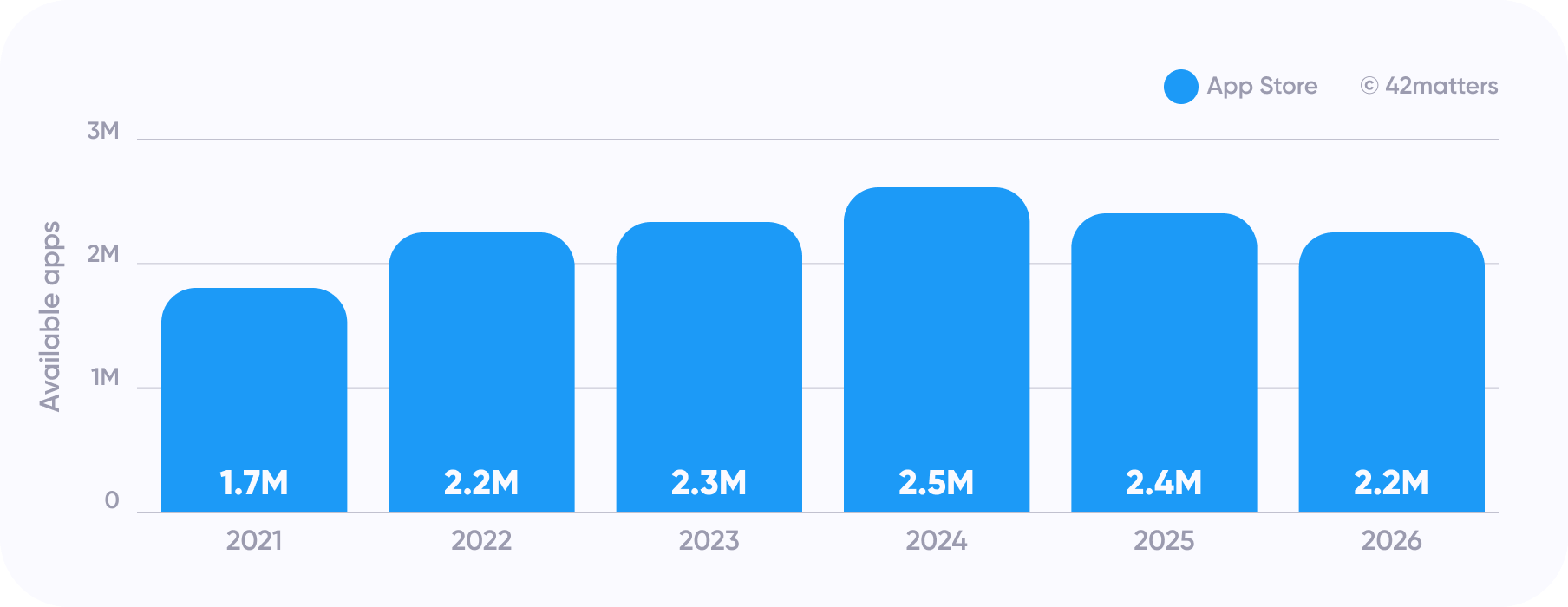
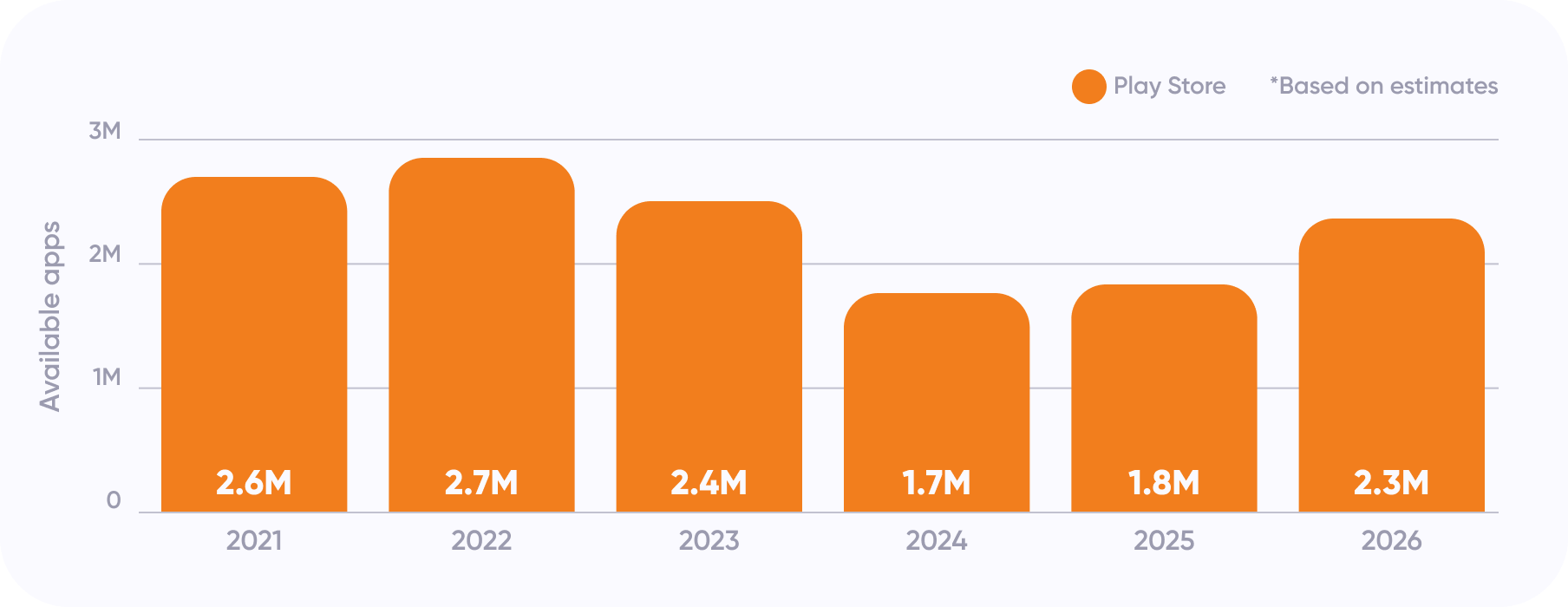
In 2026, the total number of apps across both platforms reached ~5.5 million.
Today, both stores have a relatively similar number of apps, but this was not always the case. Google Play historically led in volume, but in 2024 it removed a large number of low-quality apps that lacked updates, security, or real functionality.
This shift marks an important change in the ecosystem.
The market is no longer about quantity, but about quality and sustainability. Publishing an app is easier, but standing out and maintaining relevance has become significantly harder.
Teams now compete not only on features, but on consistency, updates, and long-term product value.
How Many Apps Are Published Daily?
According to 42matters, around ~5.7K apps are published daily, with ~3.5K on the App Store and ~2.2K on Google Play. This results in approximately 179K new apps every month.
These numbers highlight how dynamic and competitive the ecosystem has become.
Discovery is now one of the biggest challenges for any product. Building a great app is only part of the equation. Distribution, App Store Optimization, and marketing play a crucial role in determining success.
In many cases, visibility is more difficult to achieve than development itself.
Free vs Paid:
Most apps in both stores are free. However, this metric only includes apps that require an upfront payment and does not reflect the large number of apps monetized through subscriptions or in-app purchases.
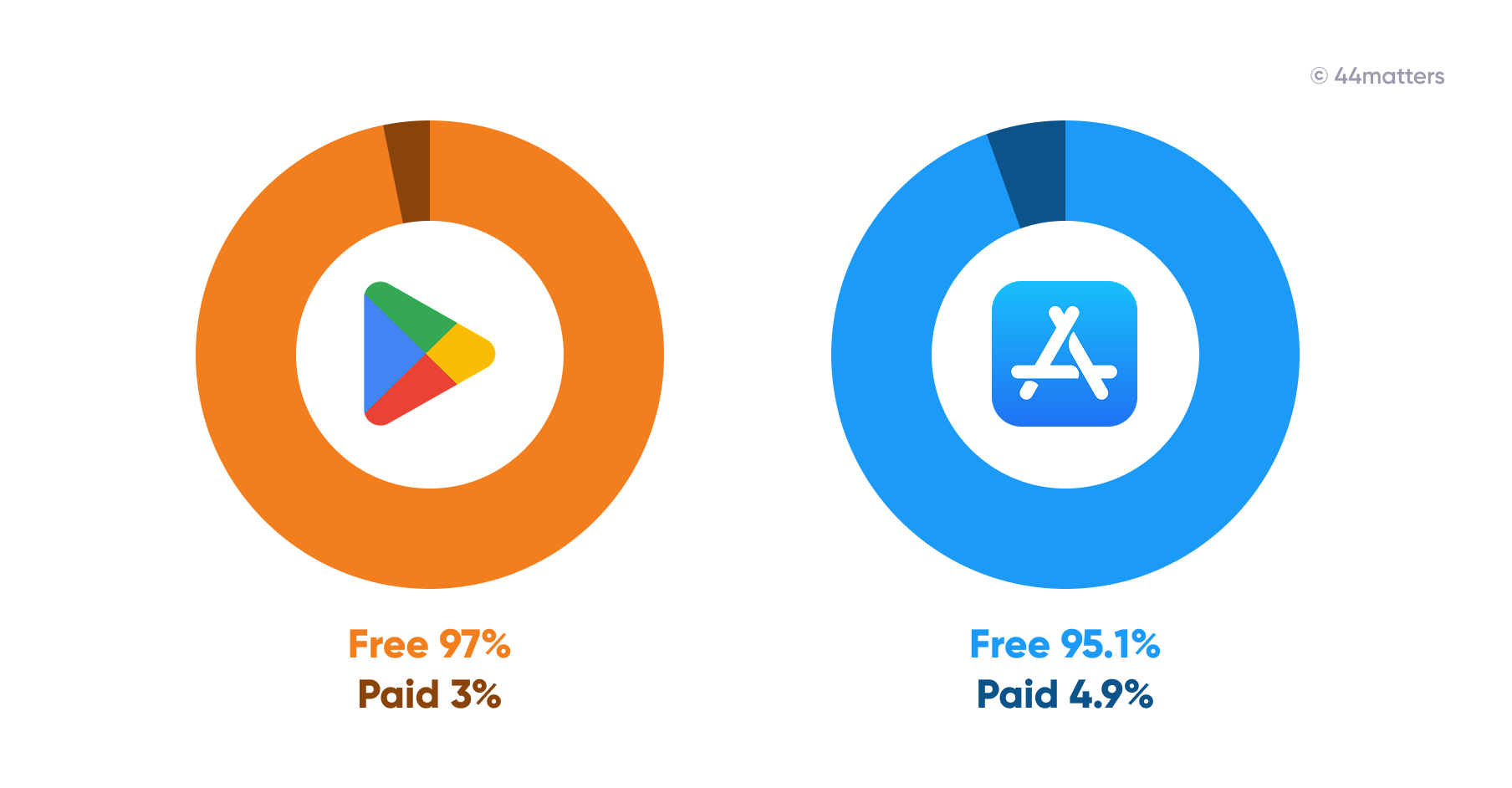
The industry has clearly shifted towards free-to-download models.
Users expect to try before they pay, and monetization now happens after the initial experience. This fundamentally changes how products need to be designed.
The focus is no longer on convincing users to download, but on delivering enough value to retain them and convert them over time.
Average App Price:
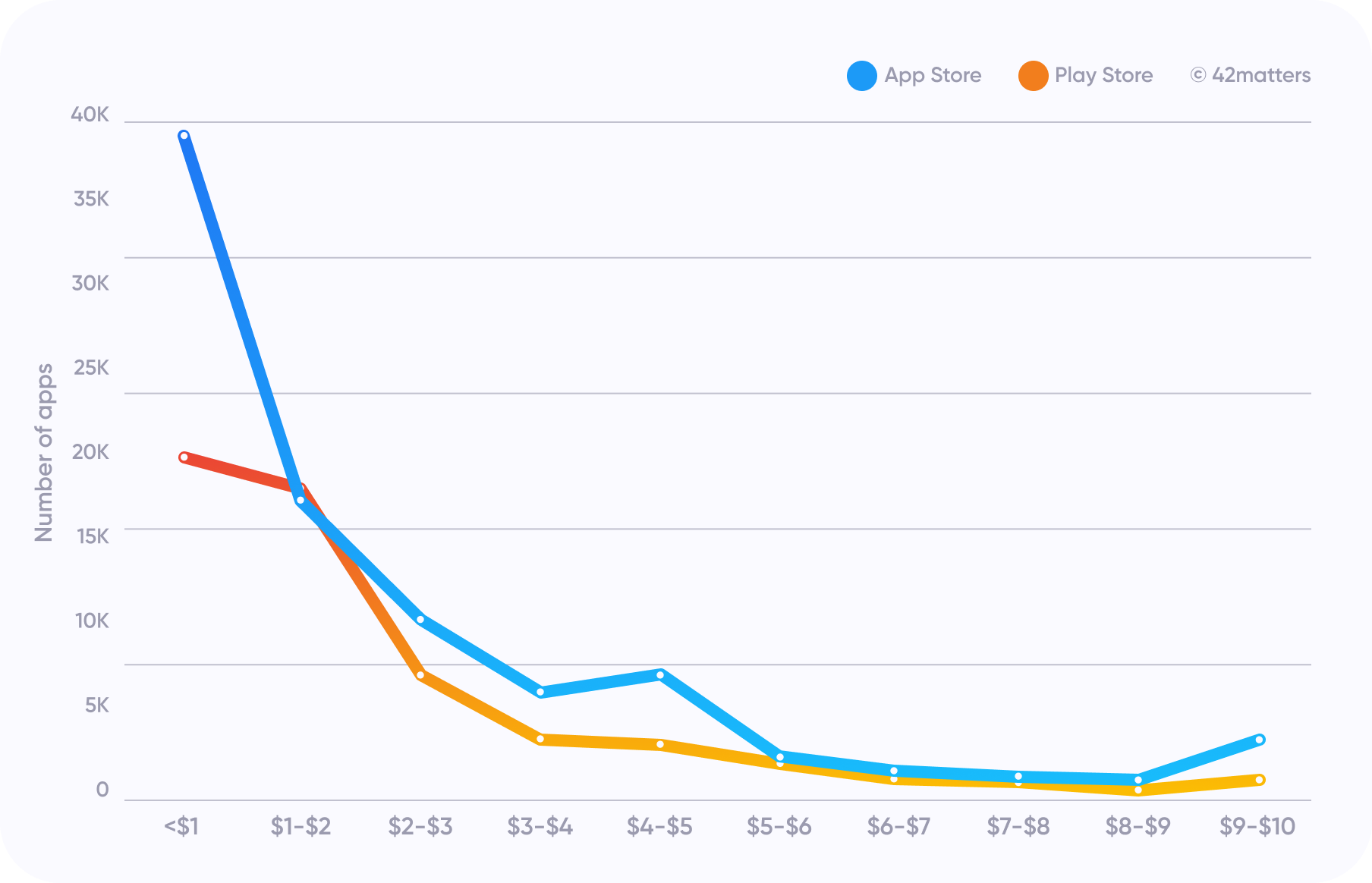
Although most apps are free, the majority of paid apps are priced under $1.
This reinforces a key behavior pattern. Users have very low tolerance for upfront costs, even for high-quality applications. Pricing is no longer a strong lever for growth. Instead, the real opportunity lies in engagement and retention.
In future articles, we will explore freemium and subscription models in more depth to better understand how apps generate revenue beyond the initial download.
Revenue: Who Generates More?
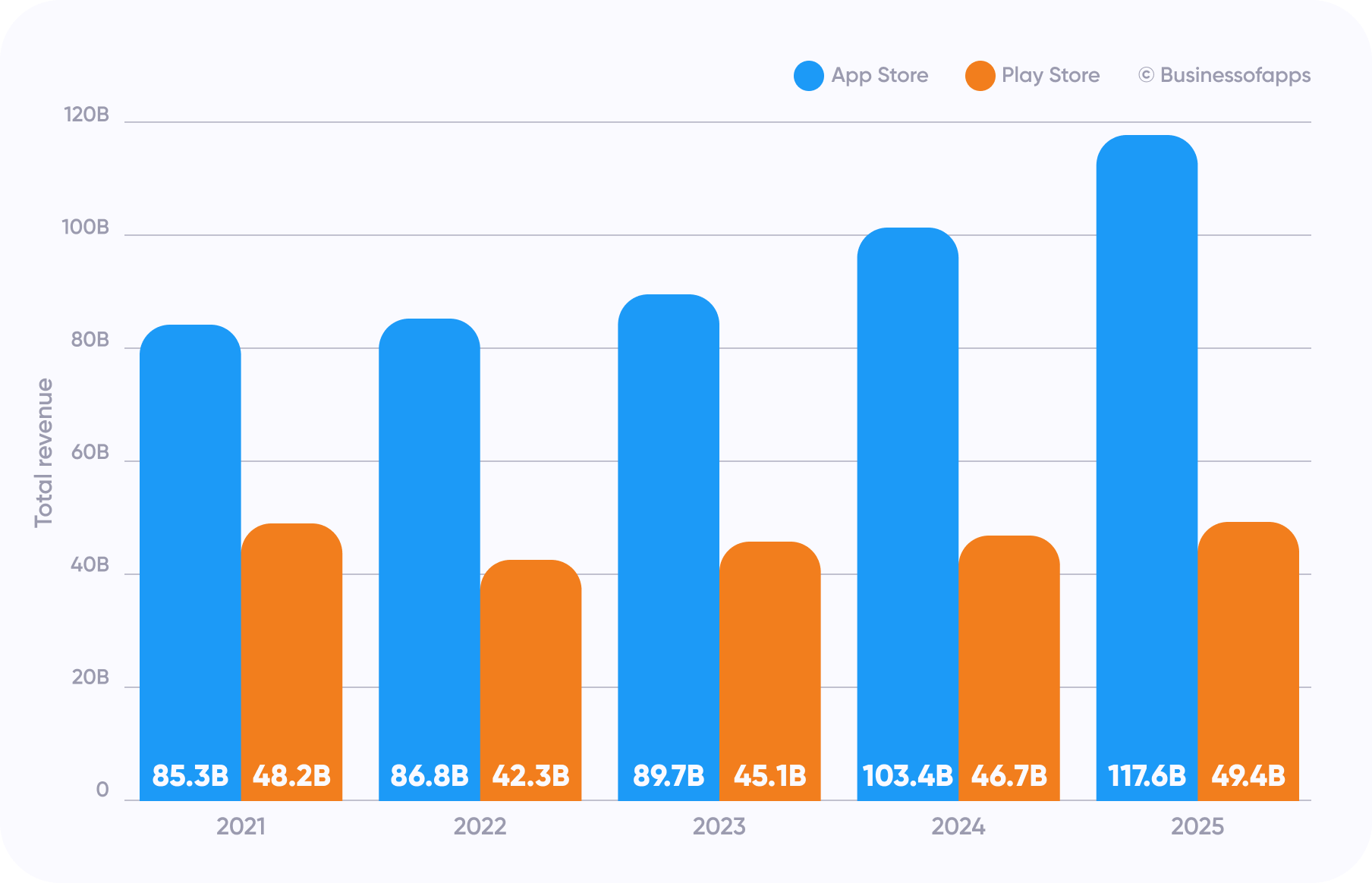
Apple’s App Store generates significantly more revenue than Google Play. In 2025, the App Store generated $117.6 billion compared to Google Play’s $49.4 billion.
While Google Play revenue has remained relatively flat in recent years, the App Store continues to grow steadily.
This highlights a fundamental difference between both ecosystems.
iOS users tend to spend more, are more willing to pay for premium experiences, and generate higher lifetime value. Android, on the other hand, offers scale but lower monetization per user.
Understanding this difference is critical when defining pricing strategies, especially for subscription-based products.
Downloads: Android Dominates Volume
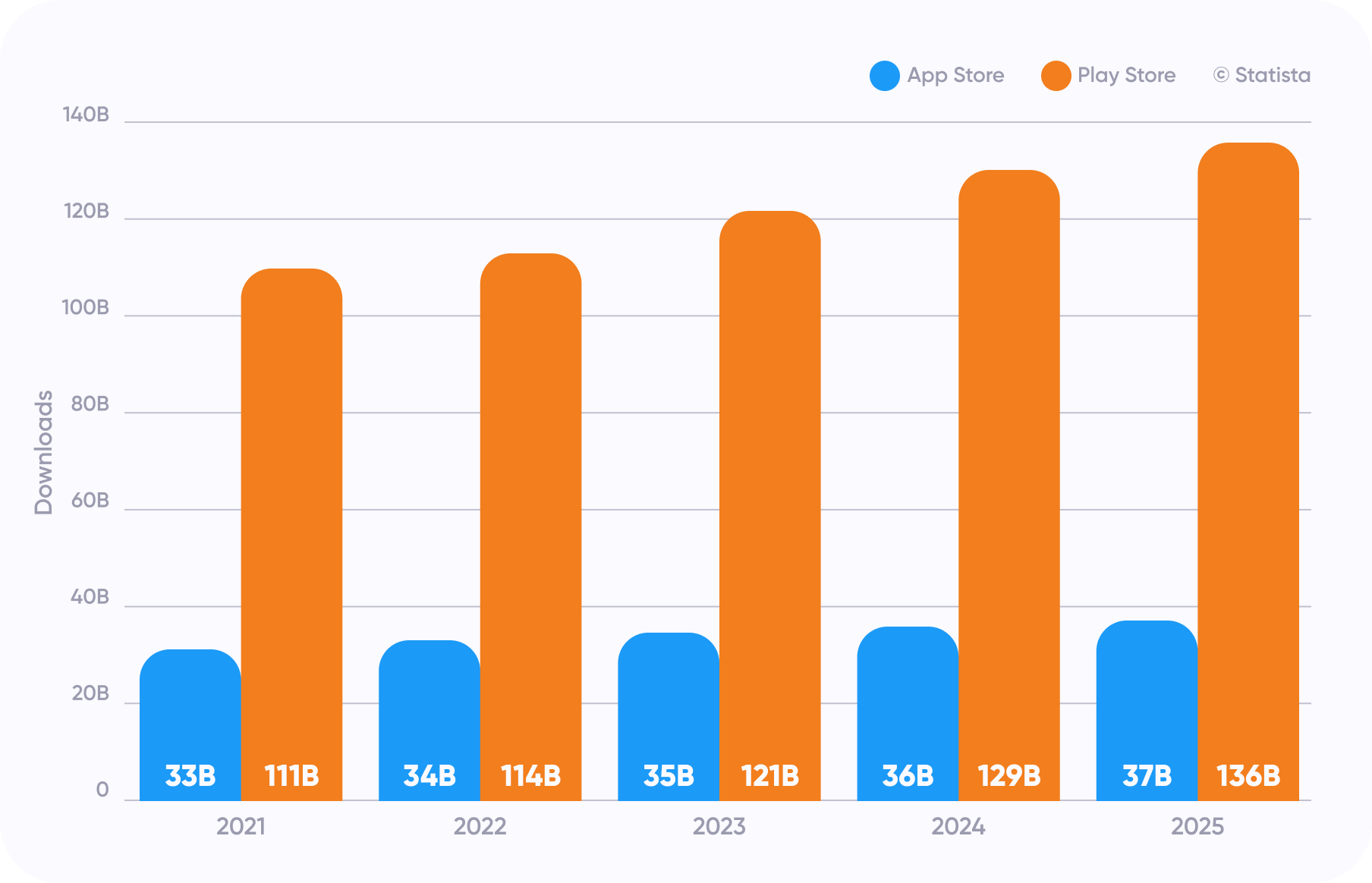
In 2025, global app downloads reached 173 billion. Android leads by a wide margin in total downloads, while iOS maintains stronger monetization despite lower volume.
This reinforces a consistent pattern across the ecosystem.
Android excels at user acquisition and global reach, while iOS excels at conversion and revenue generation.
The implication is clear. Growth strategies should not be identical across platforms. Each ecosystem rewards different behaviors and requires different optimization approaches.
Most Popular Categories (App Store)
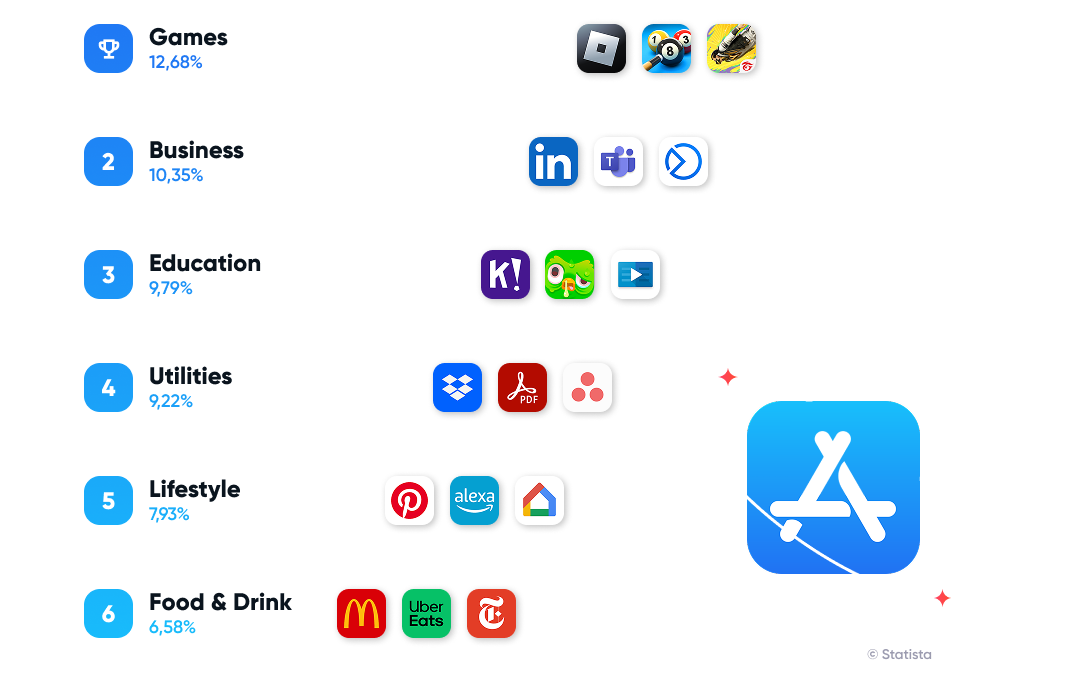
This distribution reinforces a key pattern across the ecosystem. iOS is not just about entertainment, it is also a platform where users are more willing to adopt tools that improve their daily workflows.
From a product perspective, this creates a clear opportunity. Apps focused on productivity, business, and premium experiences tend to perform better on iOS, especially when combined with strong design and polished user experience.
Most Popular Categories (Play Store)
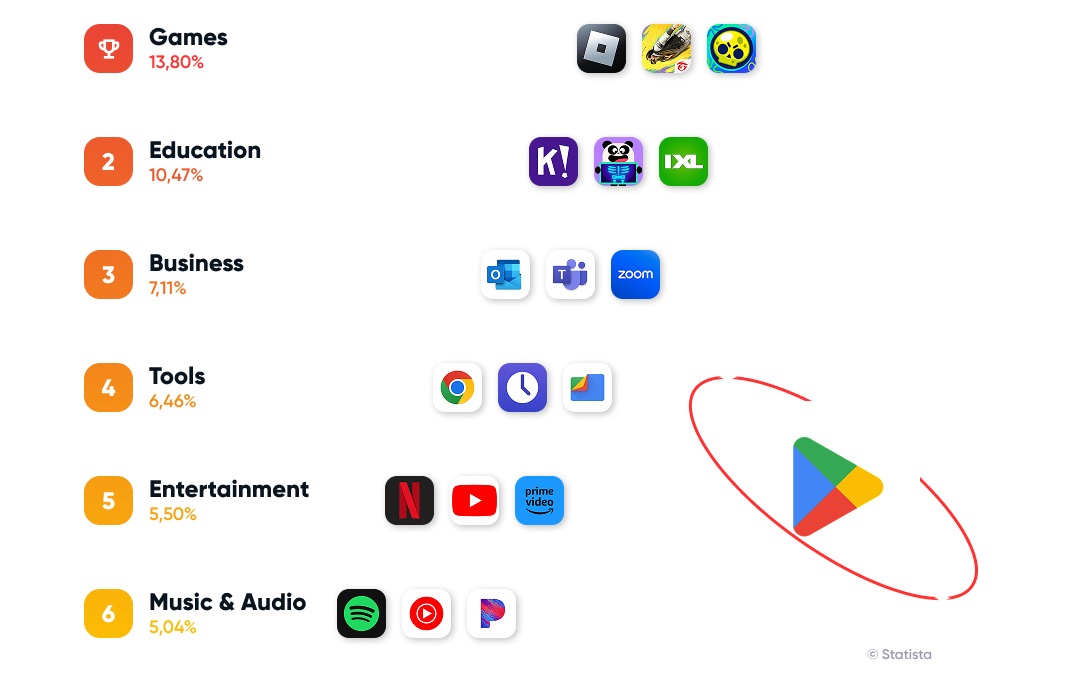
On Google Play, the distribution is slightly different. Games still lead with 13.80%, but Education takes second place, followed by Business and Tools.
Compared to iOS, Android shows a stronger presence of education and utility-driven categories, along with a more practical usage pattern overall. Categories like Tools and Entertainment also reflect how Android devices are often used as everyday utility platforms.
App Count Distribution by Rating
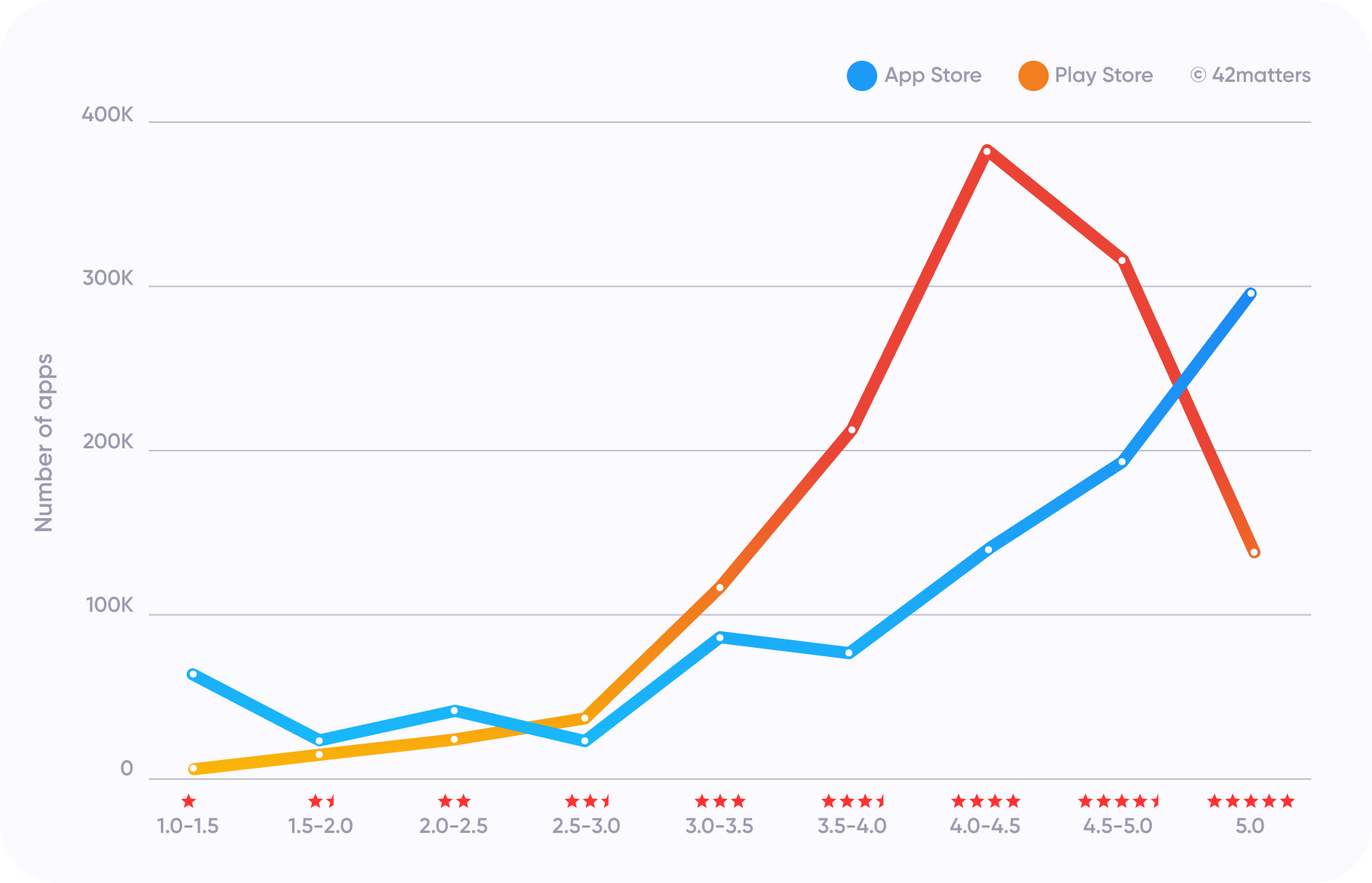
The rating curves differ significantly across both stores. Google Play is more concentrated in the 3.5 to 4.5 star range, especially around 4.0–4.5, while the App Store shows a more polarized pattern, with stronger presence at both the low and high ends of the scale.
This suggests that Android apps tend to cluster around solid but not perfect ratings, while iOS apps are more likely to fall into extremes, especially at 5.0 stars. In practice, this may reflect different review dynamics and stronger quality differentiation in the App Store ecosystem.
Conclusions
The real takeaway is not choosing between App Store and Play Store, but understanding how each ecosystem behaves.
Android offers scale, reach, and distribution, while iOS offers stronger monetization, engagement, and higher-value users.
The most effective strategy is not to choose one platform over the other, but to build for both and optimize differently for each.
At Horus, we see this constantly when building cross-platform apps.
Thank you for reading
Stay tuned and subscribe to Mobile Dev Experiences to be part of this growing community where we share strategies, insights, and real-world lessons in cross-platform mobile development.